The History of Tarot Cards
From Italian card games to the pictures tarot readers know today.
1400s
A game at the Italian card table
The earliest surviving tarot cards come from fifteenth-century northern Italy. Tarot was played as a trick-taking game. A set of illustrated trump cards made it possible to beat cards from the four ordinary suits.
Some of the best-preserved examples were luxury objects. The Visconti-Sforza cards, made in Milan, have painted figures and gold backgrounds. The familiar arrangement of 78 cards includes 56 suited cards, 21 trumps, and a separate Fool. Early packs varied in their design and sometimes in their makeup.
1600s–1700s
The Tarot de Marseille takes shape
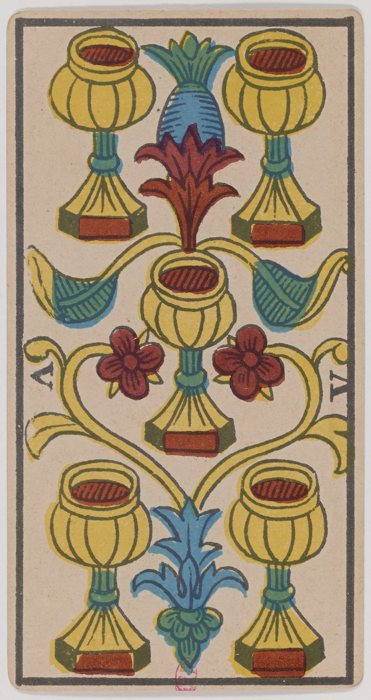
French cardmakers produced several related patterns now known as the Tarot de Marseille. A Marseille-style deck usually shows repeated suit emblems on numbered cards. On the Five of Cups, for example, the cups themselves supply the number and pattern.
Look at the trumps as well as the suit cards. The sequence and titles change among related decks. Many Marseille-pattern decks put Justice at VIII and Strength at XI. The Rider–Waite–Smith deck swaps those positions.
Late 1700s
French writers begin reading the cards differently
By the late eighteenth century, French writers were publishing systems that treated tarot as a tool for divination. In 1781, Antoine Court de Gébelin argued that tarot preserved wisdom from ancient Egypt. That theory influenced later occult interpretations. The surviving early decks and records place tarot’s beginnings in Renaissance Italy.
Jean-Baptiste Alliette, who published as Etteilla, developed a system for reading the cards and a deck designed for divination. Later readers continued to adapt the imagery and meanings for their own systems.
1909
Pamela Colman Smith gives the suit cards scenes
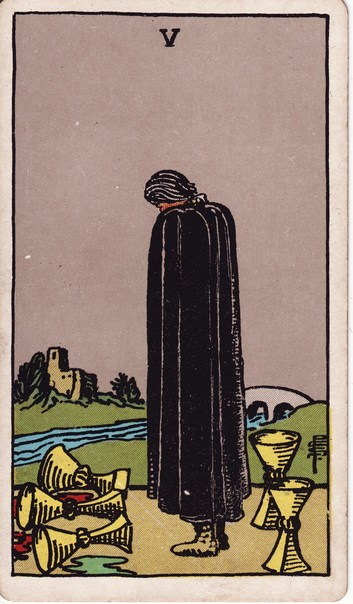
In 1909, the Rider–Waite–Smith deck appeared with illustrations by Pamela Colman Smith and a design developed with Arthur Edward Waite. Smith used people, places, and gestures throughout the numbered suit cards. The Five of Cups shows a figure facing spilled cups, with two still upright behind them.
Those scenes give a reader details to work with. You might start by noticing which way the figure faces, then ask how the standing cups change the story of loss. A different deck may invite you to start with the arrangement of the five cups instead.
Marseille–Besançon
Rider–Waite–Smith
Two common questions
Did tarot begin in ancient Egypt?
The Egyptian origin story became influential in eighteenth-century Europe. The earliest known tarot cards and records come from northern Italy in the fifteenth century.
Does every tarot deck have 78 cards?
Seventy-eight is the familiar structure today. Some historic decks varied, and modern artists also publish decks with extra cards or just the Major Arcana.