You can be curious about tarot and still have questions about its religious imagery. What are you supposed to make of an angel, a religious teacher, or the Devil? Do you need to share the beliefs behind those images to learn from them?
Add artificial intelligence to the conversation and another question appears: when a tool explains the cards for you, how much authority should you give its answer?
You can use tarot for reflection without adopting a religious belief system. You can also bring spiritual beliefs to your practice. AI can support your learning within either approach. What matters is understanding where an interpretation comes from and staying involved in deciding what it means to you.
A short history of tarot and religion
Tarot’s documented history begins with card games in fifteenth-century Italy. Its early imagery drew on the world around its makers, including familiar religious figures, social hierarchies, and ideas such as Love, Death, and Fortune. The Metropolitan Museum of Art describes its early use as a trick-taking game; the Morgan Library & Museum explains its imagery through Renaissance visual culture. Sources: The Met and The Morgan.
Occult interpretations developed later. In the late eighteenth century, writers including Antoine Court de Gébelin promoted the idea that tarot preserved ancient Egyptian wisdom. That theory became part of tarot’s later interpretation; it does not establish an ancient Egyptian origin for the cards. Source: The Morgan.
This history gives us a useful distinction: the origins of the cards, the teachings attached to them, and the meaning we find in a reading are different things. We can take all three seriously while being clear about which one we are discussing.
That distinction matters when learning from a book, a teacher, or an AI response.
Reading religious symbols in your own way
You can study a religious image and explore its meaning without adopting the beliefs it represents. You might use tarot for spiritual reflection, as a journaling practice, or as a way to consider a situation from another angle.
If you already belong to a faith, the relationship between tarot and that faith is yours to consider. People and religious communities differ on this question. A welcoming approach to tarot leaves room for those boundaries.
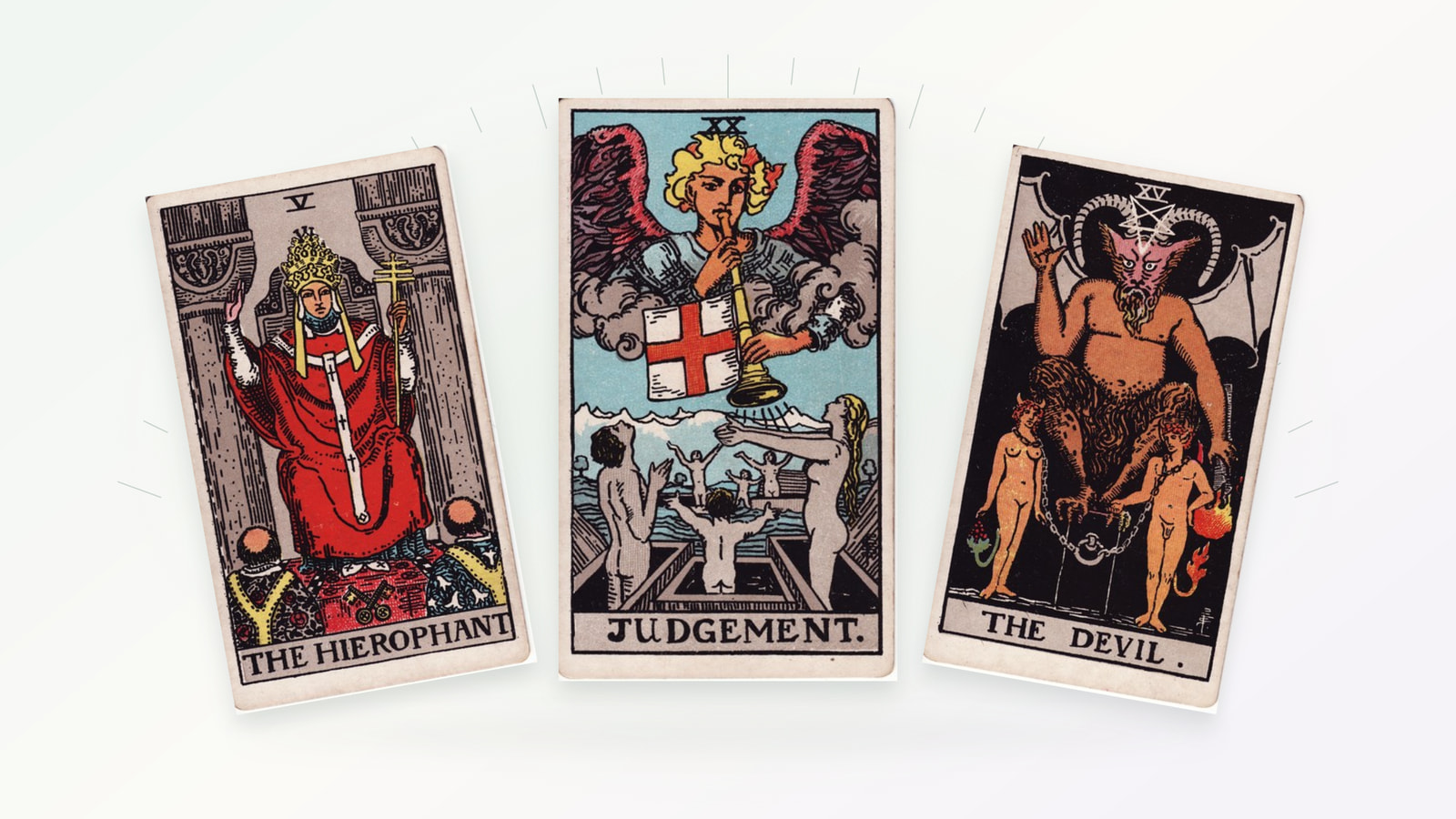
Take The Hierophant in the Rider–Waite–Smith deck. His crown, religious staff, crossed keys, and kneeling figures place him within a clear religious setting. A. E. Waite’s own explanation connects the card with religious institutions and established authority. Source: The Pictorial Key to the Tarot.
You might explore that image through faith and tradition. You could also use it to think about education, belonging, or the beliefs you inherited. One reflection question is: Which teachings support me, and which have I accepted without examining them?
The following questions are possible personal interpretations of the imagery:
| Card | Image in the Rider–Waite–Smith deck | A question to explore |
|---|---|---|
| The Hierophant | A religious leader with two kneeling figures | Who do I trust to teach me, and why? |
| The Devil | Two people chained beneath a horned figure | What habit, fear, or attachment is limiting my choices? |
| Judgement | An angel sounding a trumpet as people rise from tombs | What am I ready to acknowledge and respond to? |
The card images are described in Waite’s discussions of The Hierophant, The Devil, and Judgement.
These questions give you a way to work with the images while respecting their religious history. You can keep learning about the original symbolism as your own understanding develops.
Where AI fits into a tarot reading
The Hierophant’s question about teachers becomes especially useful here. When an AI tool gives you an interpretation, what makes it convincing? Does the explanation connect clearly to the card and your question? Or does it simply sound confident?
Text-generating AI produces responses using patterns learned during training, shaped by the input it receives. It can also produce incorrect information and fabricated citations with convincing confidence. The National Institute of Standards and Technology identifies this problem as confabulation, often called hallucination. Source: NIST Generative AI Profile, section 2.2.
For tarot, the practical implication is to treat an AI interpretation as a suggestion to examine. Its wording alone cannot establish a message from a spiritual source, reveal another person’s private thoughts, or prove a future outcome.
AI’s most useful place in a learning practice is helping you explore and explain. Try asking it to define an unfamiliar term, suggest several ways to connect a symbol to a question, or help turn your observations into a journal prompt.
You can also be specific about the approach you want: a discussion of religious imagery, a secular reflection, or a comparison of interpretations. Ask which deck or tradition an explanation draws on. This keeps your preferences visible instead of leaving the tool to assume them.
For example, if The Hierophant appears in a reading about work, you could ask:
“Show me how this card could relate to learning from an experienced colleague, following workplace expectations, or questioning an established practice. Explain which details in the image support each possibility.”
You then have several ideas to consider against what is actually happening at work. Your circumstances help you decide which interpretation is useful.
A spiritual practice can include digital tools. You can value ritual, intuition, and personal meaning while using AI to help organize or express your thoughts. The technology’s role should be clear to you.
Keep your own observation in the process
A helpful reading gives you something to think about and room to respond.
Start with what you see. Then learn about the symbolism. After that, consider how it might relate to your question. This order gives your own observations a place before someone else’s explanation fills the space.
It also helps you separate three kinds of statements:
- Observation: The Hierophant has two figures kneeling before him.
- Historical or traditional explanation: Waite connects the card with religious institutions and authority.
- Personal interpretation: This image makes me wonder how I choose my teachers.
Each statement does a different job. An observation can be checked against the image. A historical claim needs a source. A personal interpretation needs reflection and context.
AI can help you explore these layers, but keep asking which kind of statement it is making. A beautifully written paragraph still needs a reason to earn your trust.
Try a one card exercise
Choose a card from the Rider–Waite–Smith deck and give yourself a few minutes.
- Look first. Write down three details you can actually see: a gesture, an object, a colour, or the relationship between two figures.
- Notice your response. Write one sentence about what catches your attention and why. You can be uncertain.
- Ask for help exploring. Use a guidebook or try the AI prompt below.
- Compare and check. Return to the image. Check historical claims against a reliable source. Decide which suggested interpretations fit your question, and write one reflection in your own words.
“Help me study [card name] in the Rider–Waite–Smith deck. Explain the symbolism in plain language. Separate documented history, traditional meanings, and possible personal interpretations. Suggest two interpretations connected to details in the image and one journaling question. Flag anything you are uncertain about, and give sources for historical claims.”
Check the sources it gives you. Requesting a citation is a useful starting point; reading that source is how you find out whether it supports the claim.
The purpose of the exercise is to practise noticing, questioning, and making connections. You are allowed to disagree with an interpretation. You are also allowed to sit with a question before deciding what you think.
Making the practice your own
You can respect tarot’s history, explore spiritual meaning, and use modern tools while developing your own approach.
At Tarot Learning Lab, the goal is to help you understand the cards well enough to participate actively in your readings. Learn what a symbol has meant. Explore what it brings up for you. Ask how an interpretation was reached, whether it comes from a guidebook, a reader, or AI.
Your next reading can begin with one card and one question: What do I notice before reading someone else’s interpretation?